Career Guidance Week
Post introduction
Bright Path Secondary School is holding Career Guidance Week. Professionals from different fields have been invited to speak with Senior Four learners about their work, training, opportunities and challenges.
Mariam is unsure about her future, so she decides to move from panel to panel and ask as many useful questions as possible.
She does not expect the professionals to choose a career for her. She wants information that will help her think about her abilities, interests, responsibilities and future opportunities.
Career Guidance Week
Bright Path Secondary School was louder than usual.
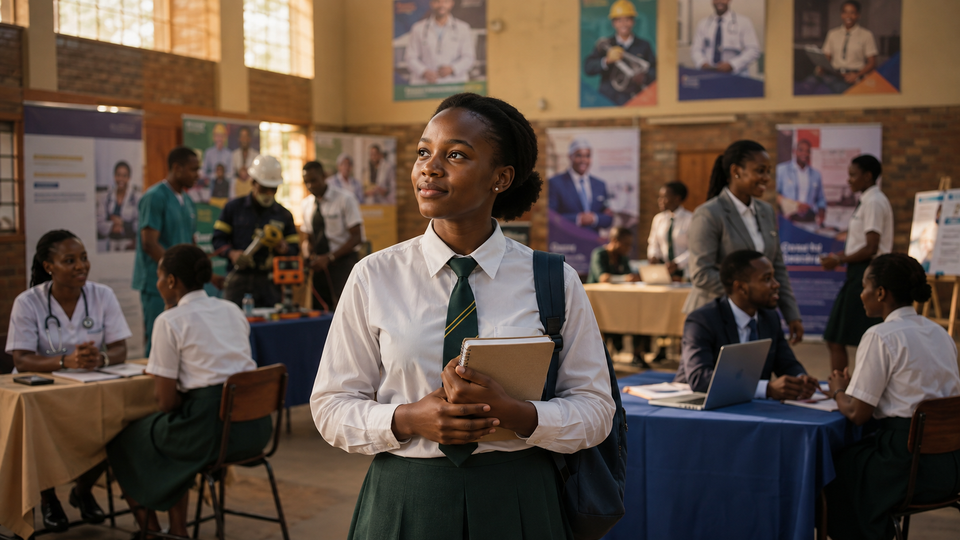
Posters covered the walls. Desks had been arranged into small presentation areas, and visitors from different professions were seated around the school hall. Some wore uniforms. Others carried tools, notebooks, laptops or samples from their workplaces.
It was Career Guidance Week.
Senior Four learners moved from one panel to another, listening to people explain what they did, how they had trained and what challenges they faced.
Mariam stood near the entrance with a notebook pressed against her chest.
For weeks, people had been asking her the same question.
“What are you going to become?”
Her mother believed nursing would give her a secure and respected future. Her uncle thought she should find work immediately after Senior Four and begin helping the family. Her technology teacher often praised her practical skills and encouraged her to consider technical training.
Mariam had listened to everyone.
The problem was that the more advice she received, the less certain she became.
She opened her notebook and wrote one question at the top of the first page:
Which career is right for me?
Then she joined the first panel.
The nurse
A nurse in a neat blue uniform was speaking to a group of learners.
She explained that nursing required scientific knowledge, patience, compassion and the ability to stay calm during difficult situations.
When the other learners moved away, Mariam stepped forward.
“What qualities does a person need to become a good nurse?” she asked.
The nurse smiled.
“You must care about people, but kindness alone is not enough. You need discipline, strong communication skills and the ability to make responsible decisions under pressure.”
Mariam wrote quickly.
“What is the most difficult part of the work?”
“The hours can be long,” the nurse replied. “Some situations are emotionally demanding. You may also have to continue studying throughout your career because medical knowledge keeps changing.”
Mariam looked at the nurse’s uniform.
Nursing was respected. It offered opportunities. It also carried serious responsibility.
In her notebook she wrote:
A secure and valuable career, but I must think honestly about whether the daily work suits me.
She thanked the nurse and moved to the next panel.
The electrical technician
The electrical technician had placed wires, switches and small tools on the table.
Mariam immediately slowed down.
She enjoyed repairing small devices and understanding how things worked. At home, relatives often brought her broken radios, chargers and torches.
“What training does an electrical technician need?” she asked.
“You can begin through technical or vocational training,” the technician explained. “From there, you can continue building your qualifications. But technical work is not only about using your hands. You must understand safety, measurement, planning and problem-solving.”
“What opportunities are available?”
“You may work for a company, join construction projects, maintain electrical systems or eventually start your own business.”
Mariam looked at the tools on the table.
This work felt familiar to her.
“What is the biggest challenge?” she asked.
“Mistakes can be dangerous,” the technician said. “A careless person should not work with electricity. You must be accurate, responsible and willing to keep learning as technology changes.”
Mariam wrote:
This matches my practical abilities, but I need to investigate the training costs and entry requirements.
For the first time that morning, she felt slightly excited.
The business owner
At the next panel, a business owner was displaying notebooks filled with budgets, customer records and plans.
Mariam waited until there was space near the table.
“Is business a real career,” she asked, “or is it something people do when they cannot find employment?”
The business owner laughed gently.
“Business is a serious career. A successful business solves a problem for customers. It requires planning, financial discipline, communication and patience.”
“What is the greatest risk?”
“Starting without research,” the business owner replied. “A good idea is not enough. You need to know who your customers are, what they need, how much the business will cost and whether people are willing to pay.”
“Can someone begin with very little money?”
“Sometimes,” he said. “But beginning small does not mean beginning carelessly.”
Mariam wrote:
Business may offer independence, but success is not automatic.
She thought about the small repair service she sometimes imagined starting. Perhaps technical work and business did not have to be completely separate paths.
The vocational trainer
The vocational trainer had photographs of learners practising carpentry, mechanics, tailoring, catering and electrical installation.
Mariam pointed to one of the photographs.
“Why should learners consider vocational education?”
“Because it develops practical skills that can lead directly to work,” the trainer replied. “It can also be the beginning of further education. A person may start with a certificate and continue to higher qualifications.”
“Some people say vocational training is for learners who have failed academically.”
The trainer’s expression became serious.
“That idea has discouraged many talented young people. Different pathways develop different strengths. The important question is not whether one path sounds more impressive. The important question is whether it supports the learner’s abilities and goals.”
Mariam looked again at the photographs.
“So choosing vocational training does not mean closing every other door?”
“Not at all,” the trainer said. “It may open a different door.”
Mariam wrote:
I should compare pathways, not rank people.
The former student
The next guest was a former learner from Bright Path Secondary School.
He explained that after school, he had accepted a temporary job while saving money for further training.
Mariam raised her hand.
“What do you wish you had known before leaving school?”
“I wish I had asked more questions,” he replied. “I knew the names of many careers, but I did not understand the daily work, the training costs or the entry requirements.”
“Did you choose the right career immediately?”
“No,” he said. “My first step was useful, but it was not my final destination.”
“Can a person change direction later?”
“Yes. People grow. Opportunities change. Sometimes you begin in one place and discover a better direction. The important thing is to make your next step carefully.”
Mariam thought about the pressure she felt whenever adults spoke as though one decision would control the rest of her life.
She wrote:
I need a realistic first step, not a perfect lifelong answer.
The AI and emerging technology expert
The final panel had attracted a large crowd.
An AI and emerging technology expert stood beside a screen showing examples of digital tools used in healthcare, agriculture, business, education and engineering.
Mariam waited patiently for her turn.
“Will artificial intelligence replace many careers?” she asked.
“Some tasks will change,” the expert replied. “Some jobs may disappear, and new ones may develop. But most careers will still require human judgement, ethics, communication, creativity and responsibility.”
“What should learners do now?”
“Build strong subject knowledge. Develop digital confidence. Learn how to solve problems and communicate clearly. Most importantly, be prepared to keep learning.”
A learner beside Mariam asked, “Should everyone become an AI expert?”
The guest smiled.
“No. Do not choose a career only because it sounds fashionable. Ask how technology may affect the career you already care about.”
Mariam looked back at her earlier notes.
Technology could support nurses. It could change technical work. It could help businesses grow. It could also create new risks and responsibilities.
She wrote:
I should ask how technology may change my career and which human skills will remain important.
The last page
By the end of the day, Mariam’s notebook was full.
She sat beneath a tree outside the classroom and read through her notes.
The nurse had spoken about service, discipline and emotional strength.
The electrical technician had described practical skill, safety and problem-solving.
The business owner had emphasised planning and research.
The vocational trainer had challenged the belief that only one type of education could lead to success.
The former student had reminded her that a first step did not have to become a final destination.
The AI expert had shown her that every career would require adaptability.
Mariam had arrived hoping that one professional would tell her exactly what to become.
Instead, every answer had given her another question.
What was she genuinely interested in?
Which abilities did she already have?
What training could she realistically access?
What responsibilities would affect her choices?
Which challenges was she prepared to face?
What first step could she take?
Mariam turned to a clean page and wrote:
My Possible Career Path
She stared at the title for a long moment.
Her teacher approached and sat beside her.
“Did you find the answer?” the teacher asked.
“Not exactly,” Mariam admitted. “But I think I now know the questions I need to ask.”
The teacher smiled.
“That may be more useful than receiving someone else’s answer.”
Later, when the class returned to the classroom, the teacher stood at the front and looked around.
“Mariam has asked the professionals her questions,” she said. “Now each of you must ask the same questions about your own future.”
Member discussion