Put the Meeting Back Together
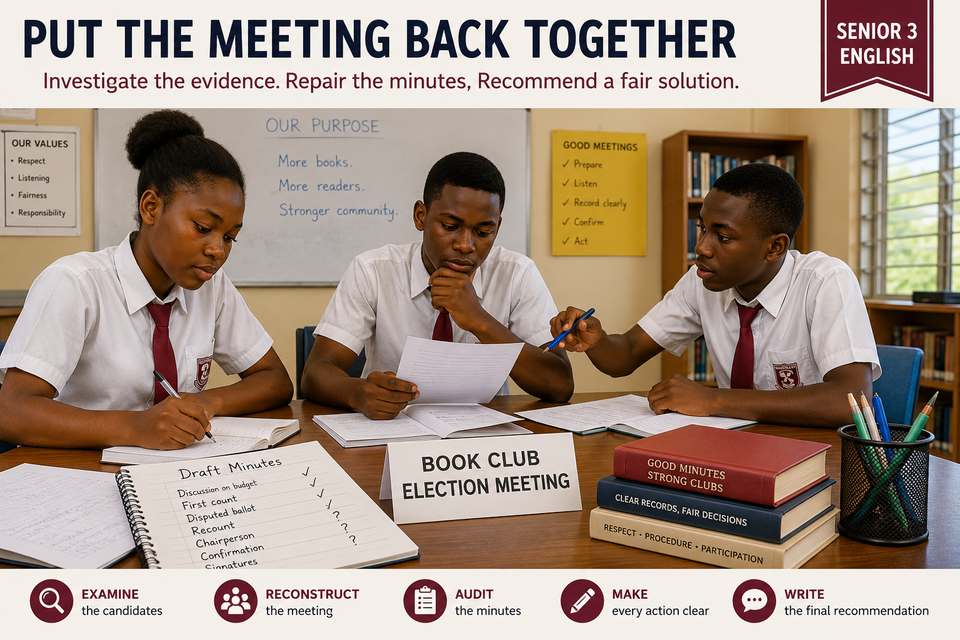
STUDENT RESOURCE · SENIOR THREE ENGLISH
Investigate a disputed Book Club election, reconstruct an unfinished meeting and recommend a fair way forward.
Core investigation: 2 periods
Complete mission sequence: 5–6 periods
Skills: Critical reading, listening, note-taking, discussion and functional writing
Grammar in action: Transitive and intransitive verbs
The Book Club had twelve members, no suitable meeting place and three chairpersons.
Democracy had become enthusiastic.
Your Challenge
The Book Club’s first official meeting ended without a trustworthy election result, confirmed decisions or signed minutes.
Your task is not to choose the candidate you like most.
You must examine the evidence, reconstruct what happened and recommend a fair way forward.
By the end of this investigation, you should be able to:
- distinguish facts from claims, assumptions and opinions;
- take useful notes from spoken accounts;
- compare conflicting evidence;
- identify weaknesses in formal minutes;
- use transitive and intransitive verbs accurately;
- reach and defend a reasoned decision; and
- write a clear formal recommendation.
THE STORY
Three Names on One Door
My name is Asha, and I joined the Book Club because reading alone had begun to feel like keeping a secret.
I loved the moment when a book changed after somebody else spoke about it. A character I had dismissed could become understandable. An ending I had accepted could suddenly seem unfair. I wanted a place where readers could question, disagree and return to the same page with new eyes.
The school library could not be that place. It was rarely empty, and the learners revising inside needed silence. The librarian allowed us to meet there once, but our discussion lasted seven minutes before Joel’s dramatic reading brought three complaints and one warning.
Outside, the old fig tree gave us shade but not shelter. Rain ended one meeting. During another, a strong wind lifted Sarah’s notes, carried two pages across the compound and pressed our attendance list against the deputy head teacher’s shoe.
That was when Sarah proposed a covered reading extension beside the library. She drew a simple plan showing a roof, open sides, two curved benches and a low shelf for shared books. At the top she wrote:
A PLACE WHERE EVERY READER HAS A VOICE
Sarah could turn an idea into a list of actions before the rest of us had finished admiring it. She had started our Friday book-exchange table, kept the borrowing list and persuaded the librarian to give us a shelf for donated books.
Moses was different. He questioned every estimate, measured the proposed space twice and knew which materials could survive heavy rain. When one of our shelves broke, he repaired it instead of waiting for somebody else to act.
Joel could make people listen. He had organised our first public reading afternoon and persuaded twenty learners to promise books, labour or small contributions. Two members who had once been afraid to read aloud had done so because he encouraged them.
Any one of them could have helped the club.
Unfortunately, all three wanted to lead it.
By Monday morning, three posters covered Sarah’s drawing on the Book Club noticeboard:
SARAH — ELECTED CHAIRPERSON: FIVE VOTES
MOSES — INTERIM PROJECT CHAIRPERSON
JOEL — ACTING CLUB CHAIRPERSON UNTIL THE PATRON RETURNS
Someone had added a fourth notice underneath them:
MEETING POSTPONED UNTIL THE CLUB DISCOVERS HOW MANY CHAIRPERSONS IT HAS.
Nobody admitted writing it.
I had written it.
It was meant to expose the foolishness of the situation, but as learners stopped to laugh at it, I wondered whether I had made the quarrel worse. The drawing of the reading extension—the reason for forming the club—had disappeared beneath three titles and a joke.
The Meeting That Went Wrong
The trouble had begun during our first official meeting on Thursday. Twelve members attended. The patron, Ms Kansiime, opened the meeting but was called to the head teacher’s office before the election began.
“Continue with the other business,” she told us. “Wait for me before making any final decision.”
At least, that is what I remember her saying. Joel later insisted that she had only told us to “continue”.
Sarah was already standing beside the chalkboard with a notebook. She had organised the meeting and drafted the proposal for the library extension. Moses sat near the window with a list of prices for timber and roofing materials. Joel moved between the desks greeting people as though the election had already ended in his favour.
Ruth nominated Sarah. She reminded us that Sarah had kept the Book Club active even during examination week.
Daniel nominated Moses because he trusted a leader who checked costs before making promises.
Mariam nominated Joel, arguing that the extension would remain a drawing unless somebody could win support for it.
Kato raised his hand before the nominations closed.
“Do we know the election procedure?” he asked. “Who will count the votes, and what happens if there is a disagreement?”
Nobody answered him properly.
“We cannot discuss a project without leaders,” Joel argued. “Let us vote while everyone is here.”
Moses objected. He said a club that ignored its own patron at its first meeting could not ask the school to trust it with money.
Sarah looked towards the door, then said that delaying every decision was another way of achieving nothing.
Emmanuel tore twelve pieces of paper from an old exercise book and offered to help count them.
I remember the first count clearly because Emmanuel called out the names while Sarah wrote the figures on the board:
- five for Sarah;
- four for Moses; and
- three for Joel.
One Ballot, Three Titles
Then Joel picked up one ballot and held it in the air. Nabirye, who was sitting nearest to him, leaned forward to examine it.
“This mark crosses two names,” he said. “That vote cannot belong to anyone.”
Sarah said the mark clearly pointed towards her name.
Nabirye said it touched both Sarah’s and Joel’s names.
Moses demanded a complete recount.
Joel accused Sarah of counting a doubtful vote in her own favour.
Sarah reminded him that he had insisted on holding the election.
Everyone began speaking at once.
We were a club created so that people could discuss different interpretations. Yet when the interpretation concerned one pencil mark, nobody wanted to listen.
While we argued, the bell rang for evening preparation. Peter and Grace left because their dormitory teacher had warned them not to be late again.
Someone cleaned part of the board so that a teacher could use it. Sarah copied something into her notebook, but I could not see whether she recorded the figures.
Ruth wanted the club to accept the first count.
Daniel supported Moses’s demand for a recount.
Mariam suggested that Joel should guide the discussion until Ms Kansiime returned.
Kato said an informal suggestion could not become an official appointment simply because people were tired.
I left before the disagreement ended.
The following morning, the disagreement followed us into the corridor.
Joel announced that Mariam and several members had asked him to maintain order until the patron returned.
Mariam agreed that she had suggested it, but Kato asked when a suggestion had become an appointment.
Emmanuel admitted that he had continued counting the ballots, yet he could not remember whether the doubtful paper had finally been accepted or rejected.
Nabirye was certain that the disputed mark had never been settled.
Sarah opened her notebook and pointed to the first figures.
“This is the only complete count we have,” she said.
Ruth stood beside her.
“A missing signature should not erase the choice of twelve members.”
Daniel disagreed.
“A number written down during an argument is not automatically a final result.”
He wanted a new election and asked Moses to keep the extension project moving until it could be held.
Moses refused to call himself chairperson.
“I can continue checking prices,” he said, “but I will not accept a title that nobody properly gave me.”
That did not stop Daniel from writing INTERIM PROJECT CHAIRPERSON above Moses’s materials list.
Peter and Grace could not settle the argument because they had left at the bell. Peter remembered hearing calls for a recount. Grace remembered Sarah asking everybody to remain, but neither of them knew what happened afterward.
By Monday, each candidate had acquired a title—one from a first count, one from an impatient supporter and one from an informal suggestion.
None had been confirmed by the patron or accepted by the whole club.
The Project Stops
The club divided around them.
Ruth would not give Joel the borrowing register because she did not recognise his authority.
Daniel would not allow Sarah to submit the budget under her name.
Mariam continued collecting promises of support for Joel, but some former students asked whether their contributions would be properly recorded.
Emmanuel placed the ballot papers in an envelope, then discovered that nobody had signed across its seal.
The three posters remained over the drawing of the reading space.
The library-extension proposal stopped.
The school bursar would not discuss money with a club that could not identify its authorised leader. The supplier would hold Moses’s estimated prices for only three more days.
Put the Meeting Back Together
At 3:35 p.m., Ms Kansiime entered our Senior Three English lesson carrying the club folder.
“The head teacher will consider the project at five o’clock,” she said. “Before then, I need a trustworthy account of what happened and a fair recommendation.”
She placed the folder on the front desk.
Inside was a single confused document: Sarah’s draft minutes. Election figures, unfinished decisions and Joel’s claim had all been squeezed into it, but the document had never been checked or signed.
I looked from the folder to the three candidates.
Sarah wanted the project to move.
Moses wanted the procedure to be trustworthy.
Joel wanted the club to attract support.
Each of them had something the Book Club needed. Their struggle to be recognised had made all three contributions useless.
“Do not tell me whom you like,” she said. “Tell me what the evidence proves.”
For once, nobody rushed to speak.
I thought about the notice I had written. It had made the school laugh, but it had not helped the club understand what had happened.
I walked to the noticeboard, removed my joke and carefully lifted the three posters. Sarah’s drawing was creased underneath them, but it was still there.
When I returned, I placed the drawing beside the damaged minutes.
“We have been arguing about the name at the top,” I said. “We have forgotten the work underneath.”
Ms Kansiime nodded towards the folder.
“Then put the meeting back together.”
That is where our investigation began.
The Evidence Table
Ms Kansiime cleared the front desk and placed four sheets of paper on it.
She labelled them:
FACTS
CLAIMS
MISSING INFORMATION
POSSIBLE SOLUTIONS
“We are not beginning with candidates,” she said. “We are beginning with evidence.”
Emmanuel brought forward the envelope containing the ballots. The seal was still closed, but nobody had signed across it.
“Can we trust what is inside?” Ruth asked.
“We can examine it,” Kato replied, “but we cannot pretend that it was protected properly.”
Ms Kansiime wrote this under FACTS:
The ballots were kept, but the envelope was not securely verified.
Sarah placed her notebook beside the envelope. Her first count showed five votes for Sarah, four for Moses and three for Joel.
“That proves Sarah won,” Ruth said.
Daniel shook his head.
“It proves that those numbers were written down. It does not prove that the disputed ballot was settled.”
Ms Kansiime looked at us.
“Which part is fact, and which part is a claim?”
We agreed that the numbers in Sarah’s notebook were a fact. Whether they represented a final result was still uncertain.
Joel reminded us that some members had asked him to guide the meeting after the disagreement began.
Mariam confirmed that she had suggested it.
“But I did not conduct an election,” she added. “I only wanted someone to restore order.”
Joel became quiet.
Moses pointed to the materials list.
“Daniel called me interim project chairperson,” he said, “but the club never voted on that title.”
Daniel slowly removed the heading he had written above the list.
One by one, the three titles began to lose their authority.
Sarah’s title depended on an unsettled ballot.
Joel’s title came from an informal suggestion.
Moses’s title came from one supporter’s decision.
None of them had been properly confirmed.
Ms Kansiime then asked Peter and Grace to describe what they remembered before leaving for evening preparation. Their accounts were useful, but incomplete. They had heard demands for a recount, yet neither had witnessed a final decision.
Nabirye explained again why he had challenged the doubtful ballot.
Emmanuel admitted that the confusion had continued after some members left.
Kato returned to the question he had asked before the vote began.
“Who was supposed to count the votes? What would happen if a ballot was unclear? Did a candidate need more than half the votes, or only the highest number?”
Nobody could answer.
The club had held an election without first agreeing on the rules.
That was the most important discovery of the afternoon.
The conflict had not grown simply because three people wanted to lead. It had grown because the whole group had trusted an unclear process and expected a clear result.
Ms Kansiime drew a line through the three titles on the board.
“We may not be able to prove who won that meeting,” she said. “But we can decide what a fair community should do when the evidence is unreliable.”
For the first time, the room stopped behaving like three competing campaigns.
We began behaving like one Book Club with a problem to solve.
Listen ,Answer then Submit in to your teach
Pause and think
Member discussion