TEACHER GUIDE:Put the Meeting Back Together
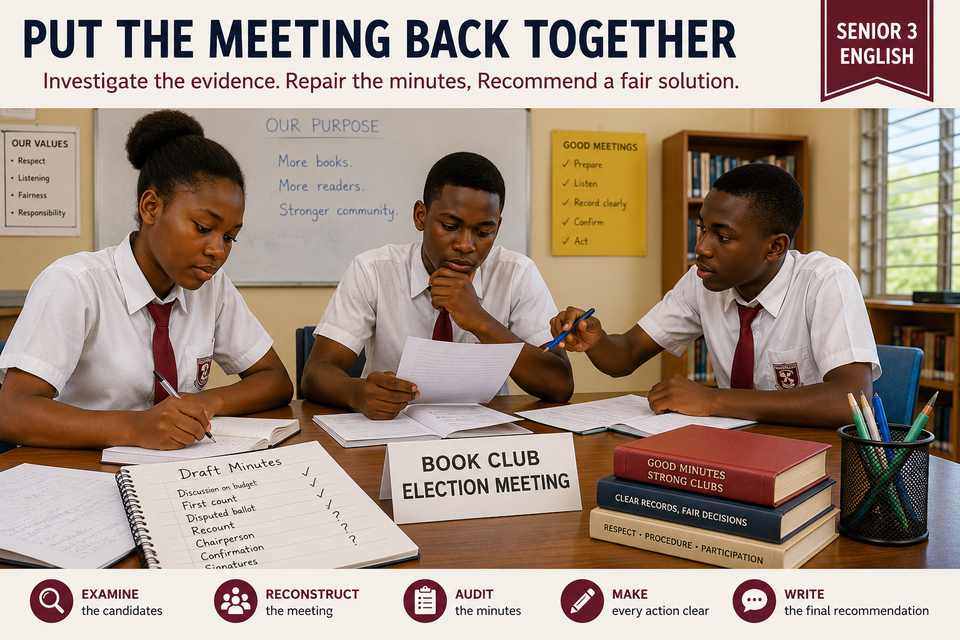
Senior Three English - School Clubs
Everything needed to introduce, teach and assess Put the Meeting Back Together.
Core investigation: 2 periods
Complete mission sequence: 5-6 periods
Assessment: Five missions worth 10 points each (50 total)
Skills: Critical reading, listening, note-taking, discussion, grammar and formal recommendation writing
Put the Meeting Back Together
This story-driven investigation asks learners to reconstruct a disputed Book Club meeting. Three capable candidates have acquired three leadership titles, but the evidence does not establish a valid final election result. Learners compare evidence, listen to witnesses, audit draft minutes, improve grammatical precision and write a formal recommendation.
Learning Outcomes
Learners should be able to:
- distinguish facts, claims, assumptions and opinions;
- take useful notes from spoken accounts;
- compare witnesses and identify uncertainty;
- identify weaknesses in formal minutes;
- use transitive and intransitive verbs accurately;
- reach and defend an evidence-based decision; and
- write a clear formal recommendation.
Preparation
- Read the student story and all five missions.
- Prepare the student workbook in print or digital form.
- Keep the three witness scripts below hidden until Mission 2.
- Decide whether to teach the two-period core or the full 5-6 period sequence.
- Prepare a board with four headings: Confirmed, Claimed, Uncertain, Missing.
Two principles: Every important conclusion must name its evidence. Learners may recommend different solutions, but they may not invent a result.
Mission 1: Separate the Candidate from the Claim
Candidate Evidence
| Candidate | Proven contribution | Supporter and valued quality | Possible limitation |
|---|---|---|---|
| Sarah | Started the exchange table, kept the borrowing list and developed the extension proposal. | Ruth valued organisation, continuity and initiative. | May press for action before procedure is settled; her notebook is not a confirmed record. |
| Moses | Checked estimates, measured the space and repaired a broken shelf. | Daniel valued caution, cost control and practical reliability. | May slow decisions; he did not accept the disputed title himself. |
| Joel | Organised public reading, attracted support and encouraged hesitant readers. | Mariam valued communication, confidence and mobilisation. | An informal suggestion was turned into an unsupported title. |
Key conclusion: All three candidates have useful leadership qualities. The evidence does not prove that any of them was properly elected or appointed.
Model Response
The evidence shows that all three candidates could contribute to the Book Club, but it does not confirm a valid chairperson. Sarah has organised activities and developed the reading-extension proposal. Moses has checked costs and solved practical problems, while Joel has attracted support and encouraged other readers. These achievements show suitability, not election victory. The disputed ballot, missing recount figures and informal appointments mean that the final result cannot be confirmed. The club still needs a trustworthy election procedure and an official record.
10 points: 3 evidence | 2 suitability vs victory | 2 missing information | 2 reasoning | 1 evidence language
Mission 2: Reconstruct the Meeting
Read each account twice. Do not display the scripts beforehand.
Witness Script A: Emmanuel
I helped count the ballot papers after the members voted. During the first count, I called out five votes for Sarah, four for Moses and three for Joel. Then one paper was questioned because its mark appeared to cross two names. People began arguing and asked for a recount. I continued handling the ballots, but the room became noisy and some members left. I cannot now confirm whether the disputed paper was accepted or rejected. I placed the ballots in an envelope the following day, but nobody signed across the seal.
Witness Script B: Nabirye
I was sitting close to Joel when he lifted the disputed ballot. The mark appeared to touch both Sarah's and Joel's names. I said that it should not automatically be awarded to either candidate. Members called for a recount, but I never heard final figures announced. Later, I heard people saying that Joel would guide the discussion until the patron returned. I did not hear a formal proposal, seconding or vote appointing him acting chairperson.
Witness Script C: Grace
I attended the meeting, but I left when the bell rang because my dormitory teacher had warned me not to be late. Before I left, members were still disagreeing about the disputed ballot. I remember Sarah asking people to remain, and I heard several calls for a recount. I did not see the disagreement resolved. I cannot say what happened after Peter and I left.
Suggested Comparison
- Confirmed by more than one witness: a ballot was disputed; a recount was requested; no clear final resolution was witnessed.
- Still uncertain: treatment of the disputed ballot; final recount figures; any formal appointment of Joel.
- Important question: Who completed the recount, and where is the final signed result?
10 points: 3 listening notes | 2 confirmed information | 2 uncertainty | 2 comparison | 1 reporting verbs
Mission 3: Audit the Draft Minutes
| Entry | Label | Reason and correction |
| Previous minutes were read and confirmed. | U/Q | No previous minutes are mentioned. Verify or remove. |
| Sarah received five votes. | C with caution | Confirmed only as the first count, not a final result. |
| A recount was requested. | C | Several accounts support this. |
| Joel is therefore acting chairperson. | U | No proposer, seconder, vote or confirmed appointment. |
| We agreed on everything. | V/U | No specific resolution was recorded; major matters remained unresolved. |
| The meeting ended around five. | Q | Exact closing and formal closure are unclear. |
| Signature spaces were empty. | C | The record was not signed or confirmed. |
Possible repairs:
- Members discussed the reading-extension proposal, but no final budget, funding source or deadline was recorded.
- A first count of 5-4-3 was announced. A recount was requested after one ballot was disputed; no final recount figures were recorded.
- Mariam suggested that Joel guide the discussion until the patron returned. No formal appointment was recorded.
10 points: 3 document problems | 2 explanation | 2 corrections | 2 conclusion | 1 formal language
Mission 4: Make Every Action Clear
Quick Check Answers
| Sentence | Verb | Object | Type |
| Sarah drafted the proposal. | drafted | the proposal | Transitive |
| Moses measured the space. | measured | the space | Transitive |
| The members argued. | argued | - | Intransitive |
| Emmanuel counted the ballots. | counted | the ballots | Transitive |
| Peter and Grace left. | left | - | Intransitive |
| The project stopped. | stopped | - | Intransitive |
| Sarah recorded the first count. | recorded | the first count | Transitive |
| The bell rang. | rang | - | Intransitive |
Suggested repairs:
- Members discussed the proposed budget.
- Members held an election, but no final result was confirmed.
- Members disagreed about the disputed ballot.
- Sarah recorded the first-count figures in her notebook.
- Members discussed the reading-extension proposal.
Do not reward a grammatically neat sentence that invents an actor or decision not supported by the story.
10 points: 3 transitive verbs and objects | 2 intransitive verbs | 2 formal sentences | 2 factual accuracy | 1 grammar and punctuation
Mission 5: Put the Meeting Back Together
Most defensible conclusion: The evidence does not establish a valid final election result or formal acting appointment. A properly supervised election is the fairest remedy.
Possible Temporary Responsibilities
| Candidate | Temporary task | Evidence |
| Sarah | Revise the proposal and request permission. | She developed the proposal and organised activities. |
| Moses | Confirm costs, materials and practical requirements. | He checked estimates, measured the site and repaired property. |
| Joel | Communicate with supporters and organise promised books or labour. | He attracted support and encouraged participation. |
Model Recommendation
Recommendation Concerning the Book Club Election and Reading-Extension Project
The available evidence does not confirm a valid chairperson for the Book Club. The first count recorded five votes for Sarah, four for Moses and three for Joel, but one ballot was disputed and a recount was requested. No final recount figures were recorded, and the claim that Joel became acting chairperson was not supported by a formal proposal or vote. The unsigned draft minutes therefore cannot establish an official result.
I recommend that the club hold a new election under Ms Kansiime's supervision. The voting procedure, counters and treatment of doubtful ballots should be agreed before voting begins. The result must be recorded, confirmed and signed. Until then, no candidate should use the title of chairperson.
The reading-extension project may continue through temporary task-based responsibilities. Sarah may revise the proposal and request permission, Moses may confirm costs and materials, and Joel may communicate with supporters. Each person should report to the patron, and no one should approve money independently. Future minutes should record exact resolutions, responsible persons, deadlines and signatures. This plan respects the evidence while allowing the club's original work to continue.
10 points: 2 evidence | 2 uncertainty | 2 election recommendation | 2 project plan | 1 organisation | 1 language accuracy
Differentiation
Support
- Read the story in sections and pause for evidence summaries.
- Provide fact/claim/uncertainty cards.
- Allow paired oral rehearsal before independent writing.
- Use sentence frames for witness comparison and recommendations.
Extend
- Draft corrected official minutes after a new election.
- Design a fair election procedure and ballot-handling rule.
- Compare witness memory, written notes and signed records.
- Write a different but defensible recommendation.
Teacher Reflection
- Did learners separate candidate quality from election proof?
- Could they identify the limits of each witness account?
- Did the document audit improve their understanding of formal minutes?
- Did grammar make records clearer rather than becoming an isolated exercise?
- Were final recommendations supported by evidence?
Member discussion