The 8:15
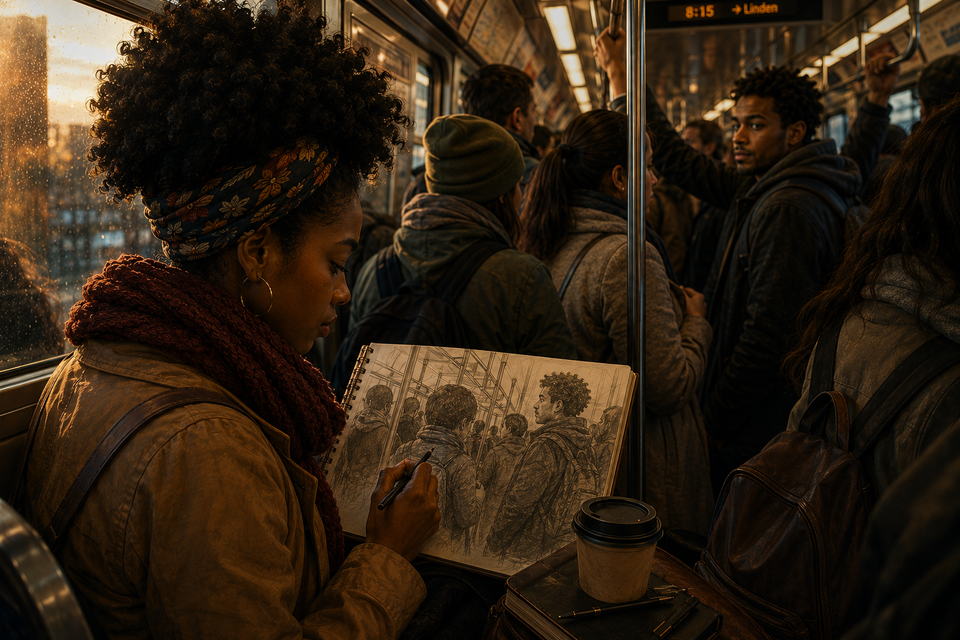
Episode One of The Quiet Space Between
An original Learn with Alicia serial novella by Alicia Lund
EPISODE 1
The 8:15
At exactly 8:15 every weekday morning, the train doors opened with the same tired sigh.
Emily stepped inside, moved past the passengers gathered near the entrance and took her usual place by the window. Not a seat—she rarely found one at that hour—but a narrow patch of floor between the second set of doors and a metal pole scratched with initials.
It was not comfortable, but it was predictable.
She liked predictable.
She wrapped one hand around the pole and held her coffee in the other. The cup was already cooling. She had made it before leaving home and forgotten to drink it, as she often did.
The carriage smelled of rain, wool coats and somebody’s overly sweet perfume. A child complained that his backpack was too heavy. Two teenagers shared earphones, their heads leaning together. A man in a dark suit typed furiously on his phone as though the morning had personally offended him.
Emily watched all of them through the glass.
Reflections were easier than faces.
They allowed her to observe without being observed.
Then the train stopped at Green Park, and Ray stepped aboard.
Emily knew his stop, although she had never asked.
She also knew that he usually entered through the third carriage, that he carried his bag over his right shoulder and that he often arrived with seconds to spare. Some mornings, the doors began closing before he reached them, and he would lift one hand in a pointless apology to the driver before squeezing inside.
Today, he was early.
He stood near the doors, shaking rain from the shoulders of his coat. His hair was damp and slightly untidy. He ran a hand through it, making it worse.
Emily looked down at her coffee.
She had first noticed him nearly three weeks earlier because of his laugh.
It was not especially loud or unusual. He had been standing with another man, listening to a story Emily could not hear. Then he laughed—not politely, not carefully, but with his whole face.
For a few seconds, he had seemed entirely unguarded.
Emily had forgotten people could look like that.
After that morning, she began seeing him everywhere on the train.
The way he read the headlines over somebody else’s shoulder. The way he moved aside for elderly passengers before they had to ask. The faint crease between his eyebrows when he concentrated on his phone.
She told herself this was what artists did.
They noticed.
It did not mean anything.
Ray looked across the carriage.
Emily turned towards the window quickly enough to spill coffee onto her thumb.
She pressed her lips together.
Outside, buildings slid past in soft grey shapes. Rain streaked the glass and stretched the city into long, watery lines.
She could feel him somewhere behind her reflection.
Or perhaps she only imagined she could.
The train lurched. Emily tightened her grip on the pole.
A woman stumbled into Ray, and he steadied her by the elbow.
“Sorry,” the woman said.
“No harm done.”
Emily heard his voice clearly for the first time.
Warm. Lower than she had expected.
She stared harder at the passing buildings.
At Central Station, half the carriage emptied. Emily found a seat but did not take it. Sitting would have meant turning away from the window, and turning away from the window would have made it too easy to look directly at him.
The empty seat disappeared beneath a woman carrying three shopping bags.
Emily felt relieved.
And then embarrassed by her relief.
She was thirty-six years old. She owned a gallery. She negotiated contracts, planned exhibitions and regularly told nervous young artists that their work deserved to be seen.
Yet the presence of one stranger had reduced her to studying rain.
Her wedding ring pressed against the metal coffee cup.
She shifted it with her thumb.
When the train arrived at Linden Street, Emily stepped onto the platform without looking back.
She told herself she did not care whether Ray watched her leave.
She made it halfway to the stairs before glancing at the train window.
He was looking directly at her.
For a heartbeat, neither of them moved.
Then the doors closed.
The train carried him away.
◆
Gallery Linden occupied the ground floor of an old brick building between a bookshop and a café that changed owners every year.
Emily unlocked the front door and stepped inside.
The gallery greeted her with its usual quiet: white walls, polished floors and paintings waiting beneath carefully positioned lights. At this hour, before visitors and phone calls, it almost felt like a place outside time.
She placed her keys on the reception desk.
A canvas near the entrance had tilted slightly overnight. Emily straightened it, stepped back, then adjusted it again.
“You know it did not move the second time.”
Emily turned.
Zoe stood in the doorway holding two coffees and a paper bag. Her bright yellow scarf was wrapped around her neck twice, although one end still trailed almost to the floor.
“How did you get in?” Emily asked.
Zoe lifted the key between two fingers, then set a coffee beside the crooked canvas. “The mysterious object you gave me and never ask back.”
“A decision I reconsider weekly.”
“Yet here I remain.” She opened the paper bag. “I brought breakfast.”
Emily looked at the cinnamon bun. “You brought cake.”
“Flour. Eggs. A respectable breakfast wearing icing.”
Zoe tore it in half and handed over the larger piece. Her yellow scarf trailed behind her as she surveyed the gallery, entirely at home in a place where she did not work.
Zoe took a dramatic bite and surveyed the gallery.
She had been Emily’s closest friend for almost twelve years and believed silence was a personal challenge. She filled rooms with questions, stories and strong opinions about things nobody else had noticed.
Usually, Emily was grateful for it.
Today, she feared Zoe would notice too much.
Zoe narrowed her eyes.
Zoe studied Emily over the rim of her cup. Emily concentrated on the lid, pressing it down long after it had clicked into place.
“Something happened on the train.”
The lid slipped from Emily’s fingers and spun across the desk.
Zoe watched it settle. “Who is he?”
Emily bent to retrieve it, grateful for the excuse not to meet her eyes. “Why must it be a man?”
“It needn’t be. A woman? A remarkably persuasive dog?”
Emily’s mouth betrayed her with the beginning of a smile.
“A man, then.”
“Someone who takes the same train.” Emily brushed an invisible crumb from the counter. “That is all.”
Zoe waited. Silence was usually her enemy; today she used it with alarming skill.
Emily tore off a piece of bun. “I have noticed him.”
“You once missed my electric-violet hair for three days.”
“It looked black indoors.”
“Exactly.”
The train window returned to Emily: Ray’s face turned towards her as the doors closed. She did not say whether he had noticed her too.
Zoe’s teasing softened. “It is good to notice things again.”
The words opened a small, dark room inside Emily. She closed it before anything could escape.
“It means nothing.”
Zoe reached for Emily’s half of the bun instead of arguing. Emily moved it out of reach.
“There she is,” Zoe said, smiling.
Emily did not ask who. For one breath, she knew.
Zoe turned towards Amina’s largest canvas and gave Emily the privacy of pretending to study it. The painting showed a row of apartment windows at dusk, each square holding a life the viewer could not enter. Emily had always liked that about it: the suggestion that intimacy could exist without explanation. This morning, the distance between the painted rooms felt less protective than lonely.
Emily gave her a look.
Zoe grinned and wandered towards the new exhibition.
The current collection belonged to a young painter named Amina, whose city landscapes were full of orange light and crowded windows. Emily had selected every piece and arranged them herself. She knew which painting drew visitors first, where they usually paused and which one they returned to before leaving.
She understood how to make room for other people’s art.
Her own was another matter.
At the far end of the gallery stood a closed door.
Behind it was the old studio.
Emily rarely entered now.
The room still contained her easels, brushes, jars of hardened paint and canvases turned towards the wall. Dust had gathered along the window ledge. A half-finished painting stood beneath a sheet near the back.
Zoe followed Emily’s gaze.
Zoe followed her gaze towards the locked studio. “We could make it usable again. Nothing has to leave.”
“No.” The word came out hard enough to stop them both.
Zoe nodded and looked back at the exhibition. The apology Emily nearly offered remained between her teeth.
Zoe nodded.
The sharpness in Emily’s voice lingered between them.
“I have to check the invoices,” Emily said.
“Of course.”
Zoe did not apologise. That was one of the reasons Emily loved her.
She simply moved towards Amina’s largest painting and began examining it as though the conversation had ended naturally.
Emily carried the coffee into her office.
On her desk lay a stack of invoices, two exhibition proposals and a notebook she had not opened in months.
She sat down.
For several minutes, she tried to work.
She read the same invoice three times. She typed the wrong date into an email. She reached for her coffee and found she had left it beside the reception desk.
Finally, she pushed the papers aside.
The notebook remained at the corner of the desk.
It was not one she used for gallery business.
Its black cover was worn smooth at the edges. A thin elastic band held it closed.
Emily touched it but did not open it.
She had carried sketchbooks everywhere once—to cafés, parks, meetings and train stations. Neil used to complain that she drew strangers more often than she drew him.
Then he would sit by the window and deliberately arrange his face into an exaggerated pose.
Emily closed her eyes.
Not now.
She removed her hand.
From the gallery, Zoe called, “I am leaving before you make me do unpaid labour.”
“You have never done paid labour here.”
“A terrible oversight.”
The front door opened and closed.
Silence returned.
Emily stared at the notebook again.
Then she reached for it.
The first pages held old sketches: hands wrapped around coffee cups, a sleeping passenger, a woman reading beside a window. Farther in, the pages became emptier.
The final drawing ended halfway down a sheet.
Emily turned to a clean page.
She picked up a pencil.
At first, she drew only a line.
The slope of a shoulder.
The edge of a coat collar.
She stopped, listening to the quiet gallery around her.
Then she added the shape of a face, the untidy hair, the faint crease between his eyebrows.
Last, she drew his eyes.
When she finished, Ray looked back at her from the page.
Not perfectly.
But unmistakably.
Emily’s heart gave a small, frightened beat.
She closed the sketchbook.
A moment later, she opened it again.
Continue the journey
Episode Two: The Empty Chair
Join Learn with Alicia to be notified when the next episode arrives.
Member discussion