The Quiet Space Between — Episode 2
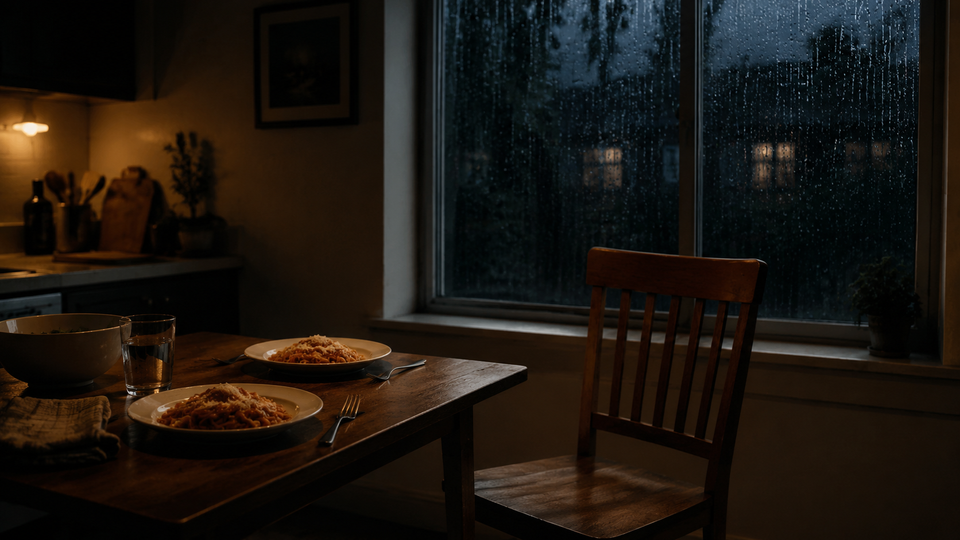
The Empty Chair
By seven o’clock, the rain had settled into a steady tapping against the kitchen window.
Emily stood at the stove, stirring tomato sauce with one hand while holding her phone between her shoulder and ear.
Zoe had been describing a new disaster involving her landlord, a leaking radiator and a man who believed tape was a permanent building material. Emily contributed small sounds in the correct places until Zoe stopped mid-sentence.
“You have not heard a word since the radiator.”
Emily lowered the heat. “Your landlord remains unreasonable. I assumed the details would support that conclusion.”
Zoe let the joke pass. She asked about the cinnamon bun instead.
Emily claimed she had eaten it while watching the sauce form a skin along the edge of the pan.
“You are cooking because you forgot to eat,” Zoe said. “That is not the same thing.”
The kitchen smelled of tomatoes and garlic. Two clean plates waited inside the cupboard, one behind the other.
Emily told her she was making pasta.
Zoe began to ask how much, then changed the sentence before it reached its final word. The care in that correction was worse than the question would have been.
Emily stopped stirring.
Rain gathered against the window. In the dark glass, her reflection appeared to be cooking for someone standing just outside the frame.
Zoe said she should let her eat.
“Stay until the sauce is finished,” Emily said.
The request surprised them both.
For another minute Zoe talked about nothing important: the colour of her neighbour’s new door, a dog wearing yellow boots, the café that had begun charging extra for oat milk. Emily listened this time.
When the sauce thickened, she promised to call the next day.
Zoe was quiet before ending the call. “It was good to see charcoal on your fingers.”
Emily looked at the grey line beside her index finger.
She did not admit that the sketchbook was wrapped inside her scarf as though the drawing might escape.
“Good night, detective.”
“Eat while it is still food, gallery robot.”
The call ended, leaving the rain and the faint hum of the refrigerator.
Emily placed the phone on the counter and returned to the sauce.
The apartment had once been too small for two people.
Neil’s shoes had filled the hallway. His books had occupied every shelf and then formed unstable towers beside the sofa. He had left mugs in rooms where no reasonable person would expect to find them.
Emily had complained constantly.
Neil had suggested they buy a larger apartment.
She had told him to put his cups in the dishwasher.
Now the rooms seemed to stretch away from her.
She opened the cupboard and reached for a plate.
Her hand passed one and closed around two.
She set them on the counter.
For a moment, she stared at them.
Then she carried both to the table.
Neil would have laughed at the pasta.
He had never believed sauce required planning. His version involved butter, black pepper and whichever cheese was closest to expiring.
“You make food too complicated,” he would say.
Emily placed two forks beside the plates. “You make food depressing.”
The answer summoned him so easily that she did not recognise the moment imagination became company.
Neil sat in his usual chair by the window, sleeves pushed to his elbows, hair needing the cut he always postponed. He looked down at the red sauce with affectionate suspicion.
“Beige is a respectable colour.”
“No artist has ever said that.”
He smiled as though the accusation proved his point.
Emily carried the saucepan to the table and served his portion first. Neil objected to the amount, just as he always had, then reached for the salt before tasting anything.
She watched the familiar movement with the relief of stepping into a room that still contained all its furniture.
“One day I may surprise you,” he said.
Emily sat across from him. “You dislike surprises more than I do.”
He raised one eyebrow. It was the expression that usually arrived before a list of his excellent qualities—patience, generosity, handsomeness—each one immediately contradicted by Emily with evidence about interruptions, hidden chocolate and doors that opened automatically.
The old argument unfolded without needing every word. She knew his pauses. He knew where she would smile.
For a few minutes, Emily allowed the rain, the steam and the imagined warmth between them to become a complete evening.
Then Neil reached for the salt again.
His hand did not arrive.
The chair was empty.
The second plate sat untouched beneath the kitchen light.
Her breathing became shallow.
She looked towards the doorway as though he might have stood up without her noticing.
“Neil?”
The apartment answered with the hum of the refrigerator.
Emily lowered her eyes.
Almost six months.
Five months, three weeks and four days since a police officer had knocked on the gallery door.
At first, Emily had thought he had come about the broken window in the neighbouring shop. She had almost smiled when she saw his uniform.
Then he said her name.
Not Mrs Taylor.
Emily.
As though he already knew he was about to divide her life into before and after.
She reached across the table and took Neil’s plate.
The pasta slid heavily back into the saucepan.
She washed the plate immediately.
She washed both forks.
She wiped the table even though nothing had spilled.
By the time she finished, her own food had gone cold.
Emily carried her plate to the bin, hesitated, then covered it and placed it in the refrigerator.
Neil had hated wasted food.
The thought came so naturally that she almost turned to tell him she had saved it.
Instead, she gripped the refrigerator handle until the metal pressed into her palm.
“I know,” she whispered.
She switched off the kitchen light.
The sitting room was darker than the kitchen.
Emily did not turn on the lamp.
She sat at the end of the sofa and listened to the rain.
Neil’s blanket lay folded over the armrest.
Blue wool. Too warm for summer, too thin for winter. They had bought it during a weekend trip after Neil insisted the colour matched Emily’s eyes.
It did not.
Her eyes were brown.
Neil had claimed that details were less important than romance.
Emily pulled the blanket around her shoulders.
The fabric no longer smelled like him.
Most things did not.
His coat had lost the scent first. Then the shirts hanging in the wardrobe. Then the scarf she had kept in a drawer because it still carried traces of his cologne and the cold air from the last morning he had worn it.
She had tried not to notice.
Grief had made her suspicious of time.
Every day took something small.
A phrase spoken in Neil’s exact voice.
The shape of his hand around a coffee cup.
The way his footsteps sounded in the hallway.
She could remember facts.
She could remember that he laughed before reaching the end of his own jokes. That he sang the wrong words to songs and refused correction. That he kissed her forehead whenever he passed behind her chair.
But facts were not the same as presence.
Facts did not fill a room.
Emily closed her eyes.
She imagined Neil beside her.
Not speaking.
Just sitting with one ankle resting on the opposite knee, his fingers tapping absently against the arm of the sofa.
For a moment, she could almost hear it.
Tap.
Tap.
Tap.
Then the rain changed direction and struck the window harder.
The sound disappeared.
Emily opened her eyes.
Across the room, the framed photograph on the bookshelf caught a line of streetlight.
Neil stood behind her in the photograph, his chin resting on her shoulder. Emily was laughing at something outside the frame.
She could not remember what.
That frightened her more than it should have.
She rose from the sofa and crossed the room.
The photograph had been taken two years earlier at Zoe’s birthday party. Neil had spent the evening pretending he could dance. Zoe had threatened to have him removed from the restaurant.
Emily lifted the frame.
“What was it?” she asked.
The smiling versions of themselves offered no answer.
“What did you say?”
She tried to return to the moment.
Music. Warm lights. Zoe wearing silver shoes. Neil’s arms around her. Someone holding a camera.
But the memory would not sharpen.
She knew she had been happy.
She could not remember why she had laughed.
Emily placed the photograph face down.
Immediately, guilt moved through her.
She turned it upright again.
“I’m sorry.”
Her voice sounded small in the room.
She carried the blanket into the bedroom.
Neil’s side of the wardrobe remained full.
Emily had moved nothing except one white shirt, which she had taken out during the first week and worn to bed until Zoe quietly washed it.
At the time, Emily had been furious.
She had accused Zoe of taking the last piece of him.
Zoe had stood in the laundry room holding the damp shirt, her face pale.
“I’m sorry,” she had said. “I thought I was helping.”
Emily had not spoken to her for four days.
Now the shirt hung inside the wardrobe again, clean and scentless.
Emily closed the door.
She changed into an old T-shirt and climbed into bed.
For almost six months, she had slept on the left side.
Her side.
She changed the fitted sheet and the duvet cover, but Neil’s pillowcase remained untouched. It had become an object she could neither use nor remove.
She reached towards his pillow.
The movement had become a ritual.
Every night, she pressed her face against it and searched for the faint trace of cedar and citrus that had once clung to his skin.
At first, the scent had been strong enough to make her cry.
Then it weakened.
Night after night, it became harder to find.
Emily pulled the pillow towards her.
She breathed in.
Laundry detergent.
Cotton.
Nothing else.
She tried again.
Deeper this time.
Nothing.
“No.”
She sat up.
Her heart began beating too quickly.
She turned the pillow over and pressed her face against the other side.
Nothing.
“No, no.”
She removed the pillowcase and searched the fabric beneath it.
She knew how desperate she looked. She knew scent could not remain forever. She knew time did not preserve anything simply because she had asked it to.
Reason did not matter.
It was gone.
The last trace of Neil’s scent was gone.
Emily stood so quickly that the room tilted.
She crossed to the wardrobe and pulled open the doors.
Her hands moved through his clothes.
Blue shirt. Grey jumper. Winter coat.
She lifted each one to her face.
Dust. Wool. Detergent.
Nothing.
Neil had disappeared from all of them.
A sound escaped her, half gasp and half sob.
Emily sank to the floor between the hanging clothes.
She pressed the sleeve of his coat against her mouth.
“I’m forgetting you.”
The words broke something open.
She had cried at the hospital.
She had cried at the funeral.
She had cried when she found Neil’s coffee in the cupboard two weeks after his death, the bag folded closed exactly as he had left it.
But this was different.
This grief felt panicked and helpless.
It was not only that Neil was gone.
Time was removing the evidence that he had ever been there.
Emily folded forward, still clutching the coat.
“I’m sorry.”
She did not know what she was apologising for.
For forgetting his scent.
For drawing Ray.
For laughing with Zoe that morning.
For living through another day that Neil had not been given.
The sketchbook waited inside her bag in the hallway.
She could see it in her mind—the curve of Ray’s shoulder, the untidy hair, the eyes she had drawn with such attention.
A stranger’s face had come easily to her pencil.
But she could no longer summon Neil’s scent.
Emily pressed the coat against her chest and cried until the wardrobe blurred.
Much later, she returned to bed.
She placed Neil’s pillow beside her and rested one hand upon it.
The rain had softened again.
Her breathing gradually followed.
Before closing her eyes, Emily looked towards the bedroom door.
Beyond it, across the dark apartment, the sketchbook remained closed inside her bag.
Neil’s scent had vanished from the pillow.
But on a clean white page, another man’s eyes waited in the dark.
Coming soon.
Member discussion