This Time, Show Us
Senior 2
Topic : Anti corruption
Leadership; oral communication; reading; language in use; persuasive
communication
Trust is not rebuilt by promises. It is rebuilt by evidence.
The Story
For nearly five months, the wooden bridge over River Kijana had remained unfinished.
The bridge connected Kijana village to the trading centre, the health centre and Bright Path Secondary School. When the river was low, some residents crossed by stepping carefully over stones. During heavy rain, however, the water rose quickly and covered the safer parts of the riverbank.
Learners who lived on the far side of the river had to wake before sunrise and walk nearly four kilometres to reach school. Traders paid young men to carry sacks through the water. Older residents sometimes postponed visits to the health centre because the longer route was too exhausting.
Everyone agreed that the bridge had to be completed.
The community had already tried once.
At the beginning of the year, the Kijana Youth Development Group had organised a fundraising campaign. Shopkeepers contributed money. Farmers donated timber. Teachers gave part of their savings. Learners at Bright Path Secondary School washed cars, sold fruit and performed songs during a school fundraising day.
For several weeks, the village had been filled with excitement.
“This bridge will show what we can achieve together,” Joel, the youth group chairperson, had declared during the launch.
But the excitement did not last.
Construction began without a complete work plan. Some timber arrived late, and several pieces were unsuitable. Nails ran out before the railing was completed. Volunteers came on days when no supervisor was present. Different people collected contributions, but the records were not always updated.
When the rainy season began, the work stopped completely.
The bridge remained half repaired.
No one could clearly explain when construction would resume.
One Saturday afternoon, residents gathered beside the unfinished bridge for a community meeting. They had not come to spread rumours or shout accusations. They had come because the bridge was still needed—and because they did not want another community project to fail.
Mama Grace, who sold vegetables at the trading centre, stood first.
“We have spent enough time asking who disappointed us,” she said. “Today, we should decide what must change.”
Several residents nodded.
Mr Lwanga, a carpenter, pointed towards the bridge.
“Some of this timber can still be used,” he said. “But before any new work begins, we need correct measurements, suitable materials and someone qualified to supervise the construction.”
“What about the money?” asked a shopkeeper. “People contributed, but we did not receive regular reports.”
A parent raised her hand.
“And what about responsibilities? Last time, everyone was invited, but nobody knew who was in charge of what.”
Joel, the youth group chairperson, remained seated near the front. When he finally stood, the crowd became quiet.
“The project was badly managed,” he admitted. “We made decisions too quickly, and we did not communicate properly. But the community still needs the bridge.”
A man near the riverbank called out, “Why should we trust another promise?”
Joel opened his mouth, but no answer came immediately.
The local council chairperson rose from his seat.
“You should not trust promises alone,” he said. “You should ask for a system that can be examined and checked.”
He explained that the district engineering office had offered to provide technical advice and some of the remaining construction materials. However, the support would not be released until the community presented a clear and transparent plan for completing the bridge.
The plan would have to explain:
- how money and materials would be recorded;
- how suppliers would be selected;
- who would approve payments;
- who would supervise the construction;
- how residents would receive progress updates;
- and how the community would confirm that the bridge had been completed properly.
The meeting became lively.
Some residents wanted the youth group to continue leading the project.
“They already know what has been done,” one woman argued. “Beginning again with completely new people may waste more time.”
Others disagreed.
“The same people cannot continue without stronger supervision,” said a trader. “Something must be different.”
A group of young residents proposed a committee containing youth representatives, elders, technical workers and contributors.
Several parents wanted the school involved.
“The learners raised money too,” one parent said. “They should not be excluded from the decisions.”
The council chairperson listened until the discussion began repeating itself.
“We will not choose a new system today,” he said. “Every proposal must first show how it will protect this project from poor management, favouritism and misuse of resources.”
He turned towards Ms Namusoke, an English teacher from Bright Path Secondary School.
“The Senior Two learners have been studying communication, integrity and anti-corruption,” he said. “Could they help us prepare a proposal?”
A few residents looked surprised.
“Students?” asked one man. “What can they tell us about managing a bridge?”
Ms Namusoke smiled.
“They may not be engineers,” she replied, “but they can study a problem, organise information, develop an argument and communicate a proposal clearly.”
Mama Grace nodded.
“Let them try,” she said. “But they should not come with beautiful words only. We have heard enough beautiful words.”
The council chairperson looked towards the Senior Two learners standing beside their teacher.
“Then that will be your challenge,” he said. “Convince this community that the restarted project will be transparent and that the bridge will finally be completed.”
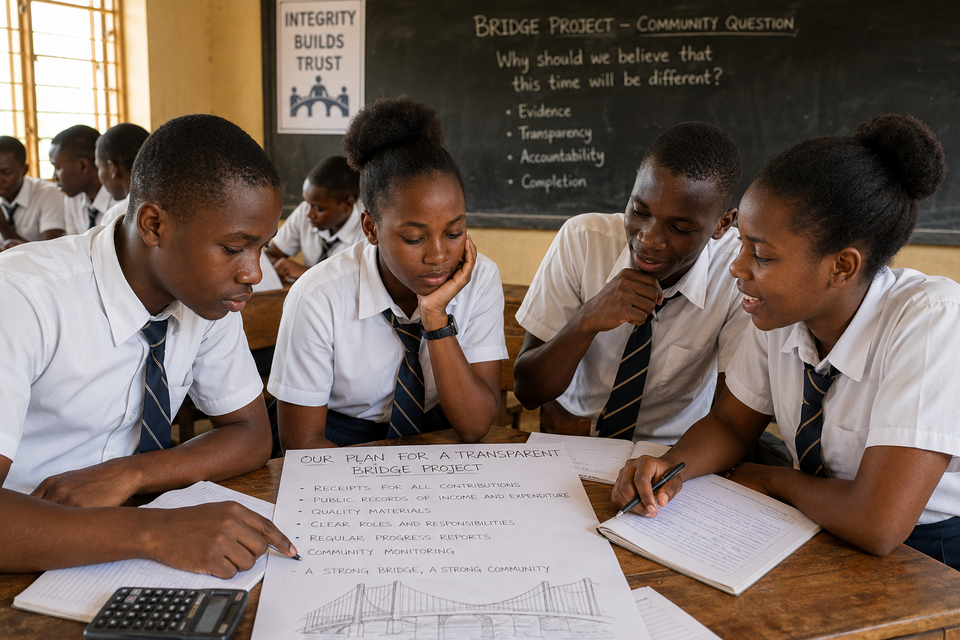
On Monday morning, Ms Namusoke wrote one sentence on the classroom board:
Trust is not rebuilt by promises. It is rebuilt by evidence.
The Senior Two learners read it silently.
On the teacher’s table were copies of the first project’s contribution records, a list of the unfinished work, three supplier quotations and a letter from the district engineering office.
Ms Namusoke divided the class into small groups.
“You are not being asked to accuse anyone,” she explained. “You are being asked to develop a better way forward.”
Brian raised his hand.
“Will every group prepare the same plan?”
“No,” Ms Namusoke replied. “Each group may recommend a different system. However, every proposal must be practical, transparent and supported by evidence.”
She pointed towards the documents.
“You must decide what will convince the community that money will be protected, materials will be accounted for, progress will be checked and the bridge will reach completion.”
Amina looked through the documents.
There were copies of the first project’s contribution records, a list of the unfinished work, three supplier quotations and a letter from the district engineering office.
The community’s question was still written on the board:
Why should we believe that this time will be different?
Ms Namusoke looked around the classroom.
“You are Senior Two students of Bright Path Secondary School,” she said. “Your task is to develop a transparent plan for completing the bridge and persuade the community to support it.”
She paused.
“Do not give them another promise. Give them evidence.”
Amina looked through the documents again.
Then she pulled a blank sheet of paper towards her.
Now It Is Your Turn
The story ends here, but the community’s problem remains. Download the learner workbook to design an evidence-based plan and persuade residents that the restarted bridge project will be transparent, accountable and completed. Teachers can use the accompanying guide to support discussion, persuasive writing, speaking and assessment.
Member discussion